
When people talk about decarbonisation, the conversation usually turns to electricity: wind farms, solar roofs, grid expansion. Yet about half of energy demand is heat, in buildings as well as in industry. We show where the heat transition stands, which examples are encouraging and which first steps industrial companies, energy utilities and municipalities can take.
Half of energy demand is heat
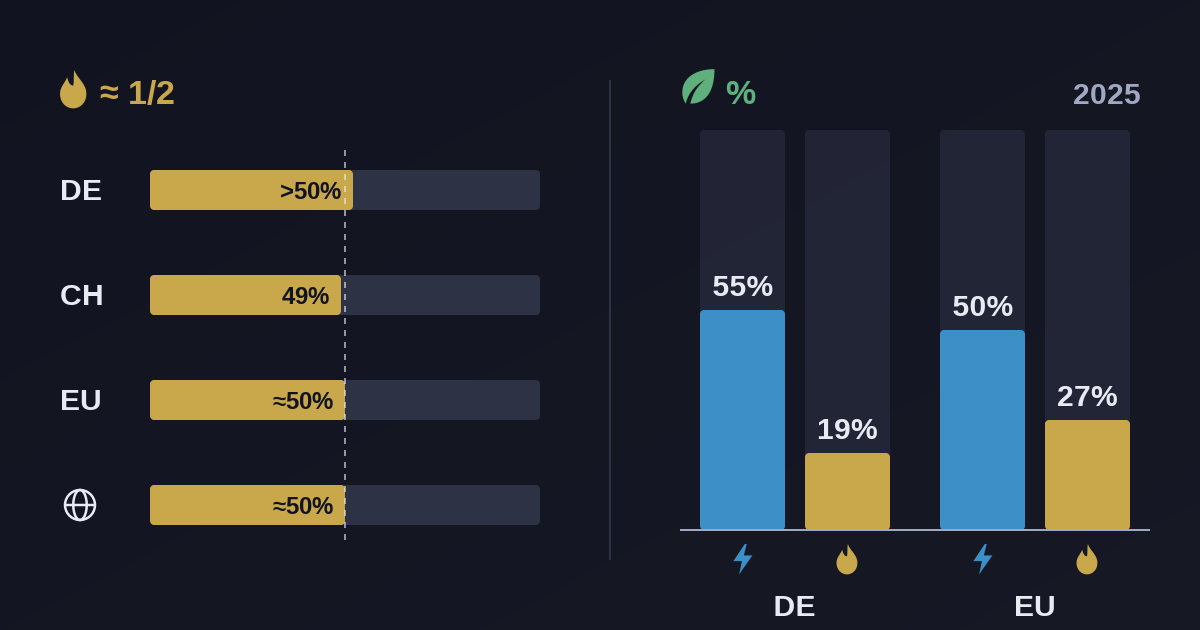
According to the German Environment Agency (UBA), heat accounts for more than 50 % of Germany's total final energy consumption. In Switzerland, the Swiss Federal Office of Energy (SFOE) attributes 30.2 % of final energy consumption in 2024 to space heating, 6.1 % to hot water and 12.8 % to process heat, together around 49 %. The European Commission puts the share of heating and cooling at around half of the EU's energy consumption. Worldwide, the International Energy Agency (IEA) reports that heat made up almost half of final energy consumption in 2024 and 37 % of energy-related CO2 emissions.
The share of renewables shows how far heat lags behind electricity. In 2025, Germany already covered 55.1 % of its gross electricity consumption with renewables, compared with around 19 % of its heating and cooling consumption. In the EU, the renewable share in 2025 was 49.9 % for electricity and 27.4 % for heating and cooling. Around two thirds of the energy used for heating and cooling still came from fossil sources in 2025. Worldwide, the IEA reports that 14 % of heat came from modern renewable sources in 2024.
The graphic above puts both side by side. On the left you see the share of heat in final energy consumption (Germany 2025, Switzerland and worldwide 2024), on the right the renewable share of electricity and heat for Germany and the EU in 2025. For us the message is clear: heat holds the largest untapped reserve for climate protection, and proven technology can unlock it.
Examples that show how it works
Denmark: planning for the long term
With its first Heat Supply Act of 1979, Denmark placed heat planning in the hands of its municipalities. Today, according to the industry association Dansk Fjernvarme, 64 % of households are connected to a district heating network. Prices may not exceed the cost of heat generation, and many utilities are municipally or cooperatively owned. Reliable planning and customer trust have carried the expansion over decades.
Vienna: wastewater as a heat source
Wien Energie uses treated wastewater from the main treatment plant in Simmering, which is between 12 and 23 °C depending on the season. The first stage of the large heat pump with 55 MW went into operation at the end of 2023 and supplies district heat at more than 90 °C for around 56,000 households. By 2027 the plant is set to grow to 110 MW for 112,000 households.
Mannheim: heat from the Rhine
In October 2023, the utility MVV commissioned a river heat pump with 20 MW of thermal capacity. It uses water from the Rhine and supplies around 3,500 households. The project was funded under the federal living lab (Reallabor) “Large heat pumps in district heating networks”.
Switzerland: heat pumps become standard, advice lowers the barrier
According to the Swiss Federal Statistical Office (FSO), every fourth residential building in Switzerland had a heat pump in 2025. At the same time, 58 % of households still heat with oil or gas, so the potential remains large. With the “erneuerbar heizen” (renewable heating) advisory programme, SwissEnergy offers free, non-binding on-site advice when a heating system more than ten years old is to be replaced. Companies and public administrations can use the service as well.
Industry: process heat goes electric
The IEA expects the share of electrically generated process heat worldwide to rise from 4 % in 2024 to 12 % in 2030. Industrial heat pumps are expected to supply temperatures of up to about 200 °C. This opens a growing share of process heat to renewable electricity and to the use of waste heat.
Sector coupling: thinking about electricity and heat together
The heat transition and the electricity transition are closely linked. According to the German Federal Network Agency, Germany had 573 hours with negative wholesale prices in 2025, compared with 457 in 2024. In these hours there is more electricity available than is needed. Large heat pumps and electric boilers with thermal storage can absorb this electricity and store it as heat for hours or days. This relieves the power system and lowers heating costs. How a storage tank makes the whole generation portfolio more economical is described in our article on large-scale heat storage.
Waste heat is also part of sector coupling. Wastewater treatment plants, data centres and industrial processes release heat that heat pumps can raise to network temperature. Vienna shows how much is available in a single treatment plant.
One detail from the statistics shows how closely the sectors are linked: in EU statistics, renewable electricity for heat pumps counts towards the electricity sector, while only the ambient heat used flows into the heat share. Every new heat pump therefore increases both shares, even if the heat statistics show only part of it.
Key Insight
Including heat in the energy strategy from the start unlocks half of the potential and uses renewable electricity twice, in the power grid and in the heat supply.
Simple first steps
Decarbonising heat rarely starts with a large generator. Usually it starts with data, temperatures and conversations. These questions help you get started:
- How much heat do you need, at what temperature level and at what times?
- Can supply and return temperatures be lowered through hydraulic balancing, better controls or adapted substations?
- Which processes, chillers or compressors release heat unused today?
- What does the municipal heat plan foresee for your area, and where can you get involved?
- Which funding fits, such as the Federal Funding for Efficient Heat Networks (BEW) in Germany, programmes of the German federal states and Swiss cantons, or free initial advice?
- Are the individual measures arranged in a roadmap that matches the target year of your company or municipality?
Practical Note
In transformation projects we often see that a sound data basis makes many later decisions easier. Measure load profiles and supply and return temperatures over a full year if possible before you size heat pumps, storage or solar thermal systems.
Making heat visible
Electricity is visible: wind turbines, solar roofs and the power price are in the news every day. Heat, by contrast, mostly stays in the basement and in the pipes. Raising awareness therefore starts with making heat tangible in figures and pictures.
Municipalities can run heat planning as an open process and show where heat comes from today and where the path leads. Energy utilities build trust when they present their generation mix and its development transparently, and Denmark is a good example. Industrial companies should report heat separately in their energy and climate reports, with quantities and temperature levels. This shows where the levers are. Low-threshold services such as the Swiss advisory programme show how expertise can reach decision-makers directly.
In our view, it pays to ask one simple question in every discussion about climate targets: how much of this is heat? The answer turns attention to half of the task, for which proven solutions already exist.
Sources
- German Environment Agency (UBA): Energieverbrauch für fossile und erneuerbare Wärme (Energy consumption for fossil and renewable heat), as of 15.05.2026
- German Environment Agency (UBA): Erneuerbare Energien in Zahlen (Renewable energy in figures)
- Swiss Federal Office of Energy (SFOE): Analysis of Swiss energy consumption 2000 to 2024 by end use (October 2025)
- Swiss Federal Statistical Office (FSO): In 2025, every fourth building had a heat pump (15.09.2026)
- European Commission: Heating and cooling
- Eurostat: Renewables make up 26% of EU energy use (23.07.2026)
- Eurostat: Small increase in renewable heating & cooling in 2024 (26.01.2026)
- IEA: Renewables 2025, Renewable heat
- German Federal Network Agency: Electricity market data 2025 (05.01.2026)
- City of Vienna: Large heat pump Simmering
- MVV: Commissioning of the first MVV river heat pump (press release, 2023)
- Dansk Fjernvarme: The Danish district heating model
- SwissEnergy: Impulsberatung “erneuerbar heizen” (renewable heating advisory programme)
Where does your heat supply stand on the road to decarbonisation?
We are happy to look at your heat supply with you, whether at an industrial site, in a heat network or in a municipality. Together we clarify which first steps pay off and how electricity and heat can work together.