
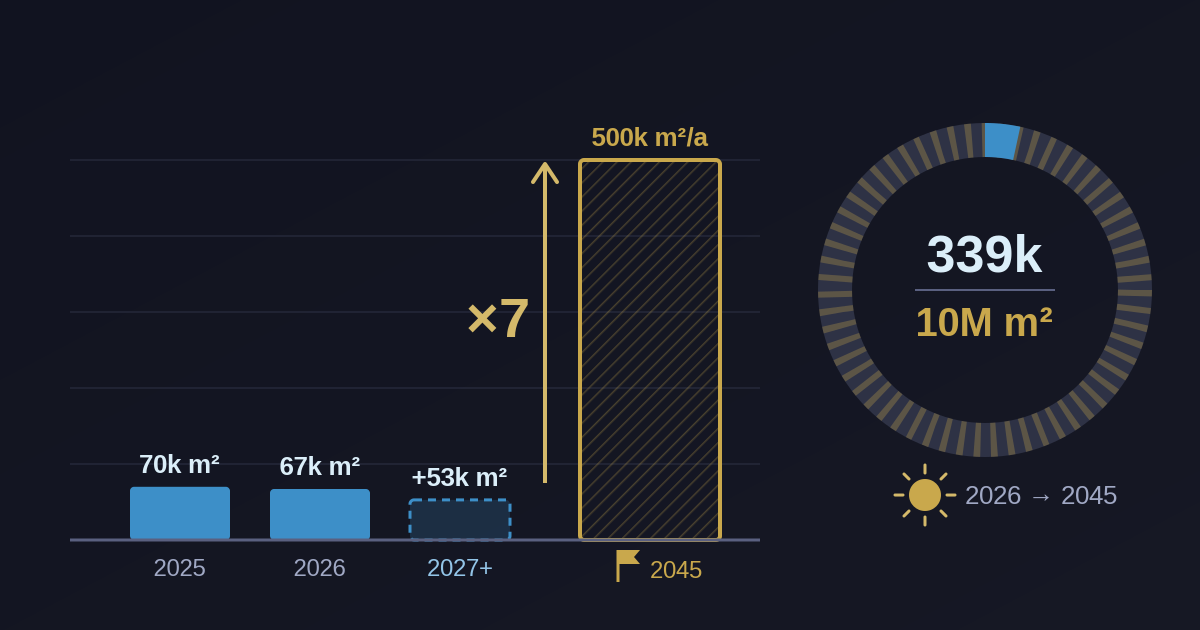
The market for solar district heating in Germany is growing noticeably again. According to the SolnetPlus market overview, as of September 2026 there are 75 solar district heating networks with a combined gross collector area of 339,203 m² and 222 MW of thermal capacity. Measured against the target, this is still only a beginning. For operators currently planning their transformation, the question is what role solar thermal can play in their own network and what needs to be done now.
Where the market stands
In 2025, eleven new plants with 69,963 m² of collector area and around 42 MW went into operation. The largest are in Stralsund (24,361 m²), Tübingen-Au (12,000 m²) and Bracht (11,637 m²). Up to September 2026, two plants with 67,094 m² were added. Most of this is Leipzig-Lausen with 65,208 m², the largest solar thermal plant in Germany. It was officially commissioned in June 2026 and, according to Leipziger Stadtwerke, covers around 2 % of the city's annual heat demand and up to 20 % on summer days.
According to SolnetPlus, seven more plants with a total of 52,727 m² and around 32 MW are under construction or in planning, including Steyerberg, Erkrath and Lübeck with 12,000 to 14,000 m² each.
Technically, evacuated tube and flat plate collectors dominate. Concentrating solar thermal, for example with parabolic troughs, does not yet exist at large scale in German district heating networks. A plant in Turnhout, Belgium, which delivers temperatures of up to 330 °C, shows that it works. For networks with high supply temperatures or for process heat, this may become interesting in the medium term. For most of today's district heating networks, the proven collector types remain the obvious choice.
The gap to the target
The study "Perspektive der Fernwärme" (Perspective of District Heating) published by Prognos in June 2024 assumes around 4 TWh of solar heat in the German district heating mix by 2045. According to SolnetPlus, this would require about 10 million m² of collector area, or around 500,000 m² of new installations per year. Additions in 2025 amounted to just under 70,000 m². They would therefore have to increase roughly sevenfold, and stay at that level for around two decades.
The graphic above shows the ratio to scale: the blue bars represent additions in 2025 and in 2026 up to September, the dashed bar (2027+) the plants under construction and in planning that will follow in the coming years, and the gold bar the required annual additions. The ring on the right shows today's stock of around 339,000 m² relative to the target of around 10 million m², a little over 3 %.
Key takeaway
The market has picked up speed, but it is about a factor of seven below the path assumed in the district heating scenarios for 2045. A large part of the gap is decided in how heat systems are assessed and planned, long before any collectors are ordered.
What holds projects back
Solar thermal is assessed as a stand-alone technology
In our view, the biggest bottleneck is understanding. Many concepts calculate solar thermal as a separate option next to large heat pumps, biomass or electric boilers, each with its own levelised cost of heat. In this comparison, it looks like a niche solution: it delivers only part of the year, needs land and on its own rarely covers more than a small share of annual heat. Its real value emerges as a building block of a hybrid system, and this value does not show up in a technology-by-technology comparison.
What does that mean in practice? We keep seeing four relationships.
First, price risk. A collector field needs neither fuel nor significant amounts of electricity, only pumping energy. Every kilowatt hour of solar heat therefore has costs that are largely fixed over its lifetime. In a generation portfolio that increasingly depends on the electricity price, this stabilises costs and with them the price formula towards customers.
Second, summer operation. With solar thermal and a suitably sized storage, the summer load can be covered over longer periods without CHP plants or boilers running in unfavourable part-load ranges. This saves fuel, reduces starts and creates windows for maintenance.
Third, the interaction with the large heat pump. The heat pump can cool the lower part of the storage further than the network alone could. As a result, the collectors operate with lower inlet temperatures and deliver higher yields. Conversely, water heated by the sun at a low temperature level can serve as a source for the heat pump. Both generators make each other more efficient.
Fourth, the operating strategy. Sunny hours are often also hours with a lot of photovoltaics in the grid and correspondingly cheap electricity. Heat pump and solar thermal then compete for the same load. A storage eases this conflict because it can absorb the solar heat and shift heat pump operation to other low-priced hours. Without a coordinated operating strategy, the generators crowd each other out.
For planning, this means: solar thermal belongs in an annual simulation of the entire generation portfolio including storage, and the assessment should be based on the costs of the overall system. Only then does it become clear whether solar thermal pays off and at what size.
Solar thermal or photovoltaics?
In projects, the question regularly comes up whether the same land would be better used for photovoltaics. After all, a heat pump can also turn electricity into heat. For heat networks, two points often speak in favour of solar thermal.
The first is the yield per area. Depending on location and temperature level, a collector field delivers about two to three times the energy of a PV plant per m², directly as heat at the level the network needs.
The second is independence from the electricity market. On sunny middays, electricity prices slip into negative territory more and more often. PV is then curtailed, or its electricity is worth little in these hours. The network still needs heat at those times, for domestic hot water, for network losses or to charge the storage. Exactly in these hours, solar thermal delivers its highest yield.
A fair calculation also includes the other side: cheap midday electricity makes heat pumps and electric boilers inexpensive in the same hours. The system simulation decides which combination fits. Where the grid connection is tight or the heat pump would only run economically for a few hours in summer, solar thermal often has the better case.
Land: think bigger
The second bottleneck is land. In Leipzig, a little more than 65,000 m² of collectors occupy around 14 ha, which is a little over 2 m² of ground area per m² of collector. Such areas are rarely available right next to the network. They compete with agriculture, commercial use and photovoltaics.
This need not rule a project out. The larger a plant, the lower the specific costs per m² of collector, and the more easily it can carry a longer connecting pipeline. Sites on the outskirts, brownfield land or areas next to wastewater treatment plants and landfills thus come within reach. The Leipzig plant itself is located in the west of the city at the edge of the built-up area. Anyone who limits the search to the immediate vicinity of the network often overlooks the best sites.
Network temperatures also matter. The lower the supply and return temperatures, the better the collector yield. Every reduction in return temperature, for example through optimised substations, makes solar thermal more economical.
What we advise operators
The most important lever comes at the start. Operators who consider solar thermal possible for their network should identify suitable land already in municipal heat planning and in the decarbonisation roadmap under Section 32 of the Heat Planning Act (WPG), deliberately widen the search radius and talk to the municipality and landowners early. Once a site has been earmarked for something else, it is usually lost to the project.
After that, an honest assessment of the summer load pays off: how much heat does the network really need between May and September, and which generators should cover this load? Only then does it become clear whether a collector field is economical without a large storage or whether a storage carries the concept.
Practical note
Always have options with solar thermal calculated as an overall system, with storage, heat pump and a joint operating strategy, based on real load and temperature data from the network. A comparison of individual levelised costs of heat regularly underestimates solar thermal.
Checklist for getting started
- Is there land on the order of a little over 2 m² per m² of planned collector area, close to the network or reachable via a connecting pipeline, and is it available under planning law?
- Are these sites identified in the heat plan and the decarbonisation roadmap?
- Is the summer load of the network known from real measured data?
- Do supply and return temperatures allow a good collector yield, or can they be lowered?
- Is solar thermal assessed in the option comparison as part of the overall system, with storage and operating strategy, and compared fairly with PV and heat pumps?
- Is it clear which other generators should run in summer and how a storage improves the interaction?
Sources
- SolnetPlus: market development of solar district heating in Germany 2026 (5 October 2026, in German)
- Leipziger Stadtwerke: Solar thermal plant Leipzig West (in German)
- Solarserver: Germany's largest plant goes into operation (18 June 2026, in German)
Is there a place for solar thermal in your network?
We are happy to look with you at which solar share fits your summer load, your temperatures and your available land. That way you know early on whether securing land and starting planning are worthwhile and how solar thermal works together with heat pumps and storage.