
Since this summer, a heat storage tank with 1,050 MWh has been in operation in Gelsenkirchen-Schalke, Germany. Steag Iqony describes it as a large thermos flask that makes heat usable at a different time than it was generated. That captures the core idea, yet it underestimates what large-scale heat storage does for the system. Its value lies in the freedom it gives to generators, the network and operations.
The Gelsenkirchen example
The storage tank at the Gewerkenstraße site holds around 31,000 m³ of water and is 57 m high with a diameter of 28 m. According to trade press reports, around 22,300 m³ of this is usable, and the tank operates as a two-zone storage with temperatures of up to 115 °C. Iqony states the storage capacity as 1,050 MWh. The investment amounted to around EUR 30 million, and the state of North Rhine-Westphalia supported the project with around EUR 7.1 million from its progres.nrw programme. If needed, the storage can supply the local district heating network for about a weekend. According to trade press reports, it was inaugurated in July 2026.
The operator's reasoning is worth a look. It wants to take in heat from waste-to-energy plants and unavoidable industrial waste heat even when customers do not need it at that moment. It wants to respond more flexibly to weather, technical availability and energy markets. And it sees the storage as a prerequisite for extending the network to new connections. That already names several of the benefits this article is about.
Tank or pit?
The term large-scale heat storage covers very different installations. For most urban networks, two designs are relevant.
Steel tank storage usually stands right next to the heating plant. Unpressurised tanks operate at temperatures just below 100 °C, while pressurised or two-zone tanks like the one in Gelsenkirchen reach higher temperatures and therefore also suit networks with high supply temperatures. They need little ground area but a lot of height, and they can absorb and release high power quickly. Their typical use ranges from hours to a few days: smoothing load peaks, running generators according to the electricity price, bridging outages. The specific costs per m³ are higher than for a pit.
Pit thermal energy storage consists of sealed basins in the ground with a floating, insulated cover. These typically hold several tens of thousands to more than a hundred thousand m³ and operate at temperatures of up to around 90 °C. The larger they are, the cheaper each m³ of storage volume becomes. This makes them suitable for seasonal storage, especially in combination with solar thermal: summer heat is stored for autumn and winter. In return, they need several hectares of land, and charging and discharging are designed for lower power.
So the choice depends on the task. Anyone who wants to manage daily peaks and electricity prices usually ends up with a tank. Anyone who wants to shift large amounts of solar heat or waste heat over months can hardly avoid a pit. In larger systems, both can make sense side by side.
Six benefits beyond charging and discharging
1. Generators run at their best operating point
Large heat pumps, CHP plants and biomass boilers work most efficiently when they run steadily close to their design capacity. Without storage, they have to follow the load, with frequent part-load operation and many starts. A storage absorbs fluctuations. The generators run more smoothly, wear less and achieve better efficiencies.
2. Power and heat markets are decoupled
The more heat is generated from electricity, the more costs depend on the electricity price. With storage, the large heat pump or the electric boiler can run specifically in hours with low or negative electricity prices. Conversely, a CHP plant can generate electricity when it is expensive and store the heat for later. The storage thus turns heat operations into a tool in the electricity market without customers noticing anything.
3. Less installed capacity
A storage covers load peaks, such as the morning peak on cold days. This allows a smaller peak load capacity, and fossil peak boilers run less often. The same applies to large heat pumps on the electricity side: if the plant runs more hours at lower output thanks to storage, the grid connection can be smaller. With long waiting times for grid connections, this can decide whether a project can be implemented at all.
4. Heat that would otherwise be lost
Waste incineration, industrial waste heat and solar thermal deliver heat at their own pace, independent of customer demand. Without storage, part of this heat is cooled away or never tapped in the first place. With storage, this heat can be used in full. For solar thermal, storage is often the precondition for a collector field to make sense beyond the pure summer base load.
5. Security of supply and room for network expansion
If a generator fails, the storage bridges the time until it restarts or until a backup boiler comes online. In Gelsenkirchen, according to the operator, this is enough for about a weekend in the local network. At the same time, the storage creates reserves to connect new customers before additional generation capacity has to be built.
6. Better temperatures and stable hydraulics
A well-stratified storage keeps hot water at the top and cold water at the bottom. From the lower zone, heat pumps and solar thermal receive low inlet temperatures, which improves their efficiency. Depending on the design, unpressurised tanks can also take on tasks in pressure maintenance and serve as a water reserve for the network. This should be coordinated with the network hydraulics at an early stage.
What storage delivers economically
In conversations with operators, we often hear the same objection: a storage costs money but does not generate a single kilowatt hour of heat. So why not build another generator right away?
The question is legitimate, and the answer lies in the economics of the other plants. A storage changes when, with what and at what cost the network generates its heat. In concrete terms, its value shows up in these items:
- Cheaper electricity purchasing: heat pumps and electric boilers run in hours with low or negative prices. This directly lowers the operating costs per MWh of heat
- Higher electricity revenues: CHP plants generate in high-price hours and store the heat for later
- Avoided investments: peak boilers, heat pumps and the grid connection can be smaller because the storage covers the peaks. A smaller connection also reduces capacity-based grid charges
- Less fuel and lower CO2 costs: fossil peak boilers run less often
- More full-load hours for renewable generators: the more hours heat pumps or solar thermal can operate usefully, the lower their specific levelised cost of heat
- Less wear and maintenance: fewer starts, less part-load operation
- Additional sales: new connections without immediately building new generation capacity
- Funding: in Gelsenkirchen, the state covered almost a quarter of the investment
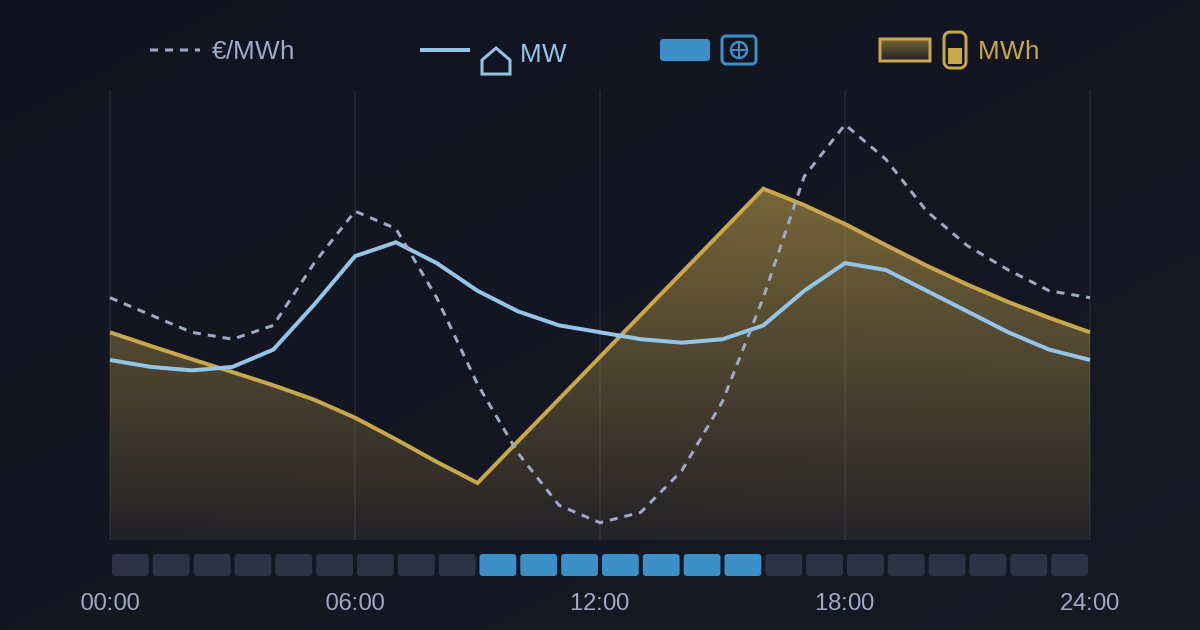
The graphic above shows the principle on a schematic day without measured data. The electricity price (dashed) drops sharply at midday. In exactly these hours, the large heat pump runs (blue blocks) and charges the storage (gold area). In the evening, when load and electricity price rise, the storage covers the peak and the heat pump stays off.
An additional generator adds capacity, but it has to use electricity or fuel itself and runs at part load in many hours. A storage, by contrast, makes all existing generators more economical. Which option pays off in a specific network can only be shown by a direct comparison in a dispatch simulation: once with an additional generator, once with storage, each based on the costs of the overall system.
Key takeaway
Large-scale heat storage is a central element of the operating strategy. It helps determine how large generators and grid connections need to be, when they run and how much renewable heat and waste heat the network can actually absorb.
What matters in planning
These benefits lead to a simple sequence. First, define which tasks the storage should take on. Only then determine size, design and integration.
Two parameters must be distinguished: the capacity in MWh and the charging and discharging power in MW. A storage for electricity market optimisation needs high power for short periods. A storage for solar thermal or waste heat needs plenty of capacity instead. This, together with the temperature level of the network, determines the design.
Then there are site and permitting. A 57 m high tank shapes the townscape, a pit storage needs several hectares. Both should appear early in heat planning and in the decarbonisation roadmap.
Practical note
Always assess a storage with a dispatch simulation of the entire generation portfolio over a full year, including electricity prices, load profiles and availabilities. Only then does it become clear which part of its value comes from efficiency, from the electricity market and from saved capacity.
Checklist for your storage concept
- Which of the six tasks should the storage take on, and which has priority?
- Is a tank or a pit storage the better fit for this?
- Has the storage been assessed in a direct comparison with an additional generator, based on the costs of the overall system?
- Have capacity and charging and discharging power been derived separately from these tasks?
- Do storage temperature and design match the supply and return temperatures of the network?
- Has it been checked whether the storage saves peak boilers or electrical connection capacity?
- Has integration into pressure maintenance and hydraulics been clarified?
- Have site and permitting been coordinated early with the municipality and heat planning?
Sources
- Iqony: press release on the Gelsenkirchen heat storage (18 January 2024, in German)
- State of North Rhine-Westphalia: groundbreaking for the thermal storage in Gelsenkirchen (4 May 2024, in German)
- Solarserver: Steag Iqony commissions large heat storage (9 July 2026, in German)
Which tasks should your storage take on?
We are happy to work out with you which benefits a large heat storage would actually bring to your network and how size, design and operating strategy follow from them. That way, the storage is planned from the start for the tasks you need it for.