
In many companies, the heat supply has been running reliably for years. That is exactly why hardly anyone takes a closer look: systems were designed for earlier processes, temperatures were never questioned, and waste heat disappears through the roof. We show seven levers for greater energy efficiency in industry, commercial buildings and heat networks, from heat recovery to return temperature, each with before-and-after figures.
Industrial waste heat: what remains unused
Under the German Energy Efficiency Act (EnEfG), companies with a final energy consumption of more than 2.5 GWh per year report their waste heat to the federal waste heat platform, for the first time by 1 January 2025 (as of 16 November 2026). An analysis by the Institute for Work and Technology (IAT) counts 4,662 sites there with around 19,065 waste heat processes (data as of 14 January 2025). At 2,797 sites, the waste heat averages at least 50 °C and is available for at least 12 hours a day. It is suitable for space heating, preheating or as a source for a heat pump.
According to klimaaktiv, the climate protection initiative of the Austrian climate ministry, around 40 % of industrial fuel use in Austria goes into steam systems. Even relatively simple measures can reduce consumption there by at least 10 %.
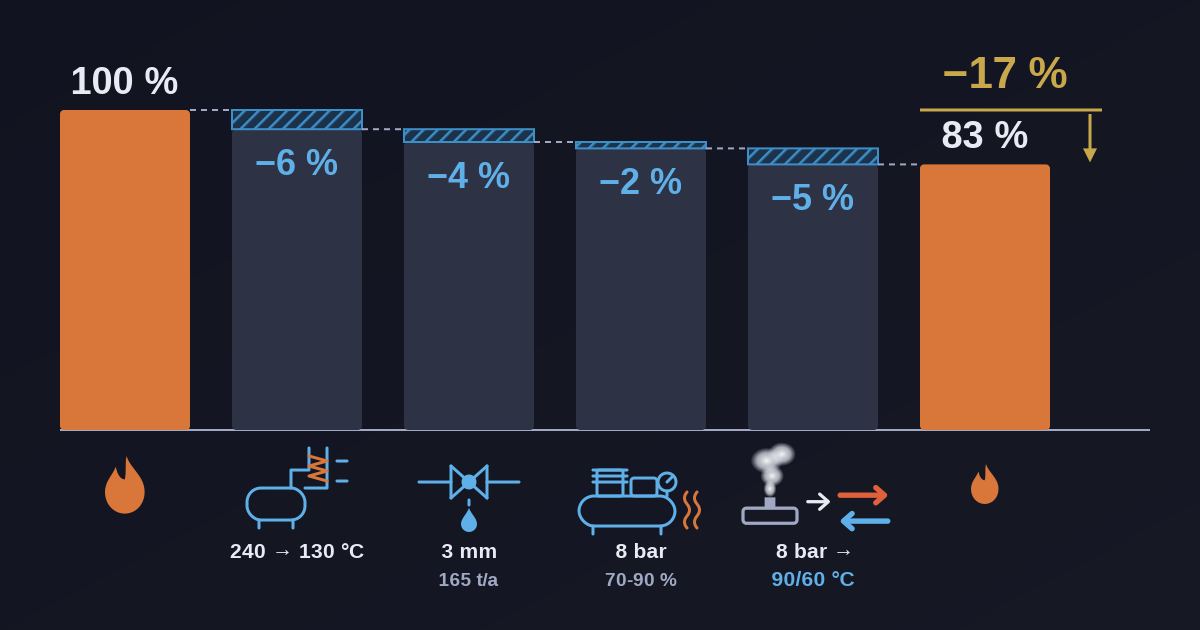
The graphic above shows an example calculation for an industrial plant with a steam boiler. Starting from 100 % fuel input, an economiser saves 6 %, tested steam traps and repaired leaks 4 %, heat recovery from compressed air 2 % and switching part of the consumers from steam to hot water 5 %. The result is 83 %. With 10 GWh of natural gas per year, that is 1.7 GWh less, around €100,000 at an assumed 6 ct/kWh and around 340 t of CO2 per year. The breakdown is our estimate; in an individual plant it will look different.
Energy efficiency in industry: the biggest levers
1. Steam only where it is really needed
In many plants, a central steam boiler supplies all consumers, including those that need much lower temperatures. Typical examples are CIP cleaning, pasteurisers and bottle and crate washers in the food and beverage industry, degreasing and pretreatment before painting in metalworking, or heated process baths in surface treatment. These processes usually run at 40 to 90 °C and are nevertheless heated via steam heat exchangers. If you sort all consumers by their actual temperature demand, this group can be supplied by a hot water network at, for example, 90/60 °C instead of 8 bar steam. This reduces distribution and condensate losses and opens the door to process heat from heat pumps and waste heat, which could hardly be used at steam level. In our example calculation, this step saves 5 % of fuel.
2. Check steam boilers and steam traps
According to the German Energy Efficiency and Climate Protection Networks Initiative, 15 to 25 % of steam traps fail each year unless they are tested at least annually. In the initiative's example, a single leak of about 3 mm in diameter lets around 23 kg of steam escape per hour, around 165 tonnes per year at 7,200 operating hours. By our rough calculation for 8 bar steam, this corresponds to 120 to 140 MWh of natural gas depending on the feedwater temperature, or €7,000 to €8,500 per year for a single leak at an assumed 6 ct/kWh. At the steam boiler itself, klimaaktiv puts the savings from an economiser and condensing heat recovery at up to 10 % of fuel input. The flue gas temperature typically falls from around 240 to 130 °C. A properly designed steam distribution system with condensate return reduces distribution losses by up to 30 %.
3. Heat recovery from compressed air, refrigeration and processes
Compressors, refrigeration systems, dryers and furnaces continuously release waste heat that is often lost unused. With heat recovery at an air compressor, the efficiency networks state that 70 to 90 % of the electrical drive energy can be used as heat at 50 to 90 °C. Their example from metalworking: a 75 kW compressor with 1,600 operating hours releases around 86,000 kWh of heat per year. Before, it went unused; afterwards, heat recovery saves around 27,000 kWh of natural gas per year. With an investment of €9,200, this pays back after 2.6 years. Heat recovery at refrigeration systems works on the same principle: heat on the condenser side preheats domestic hot water or the heating return.
4. Cascade temperatures
Heat can be used several times if consumers are arranged in the right order. The return flow of a high-temperature consumer can be the heat source for a consumer with lower demand, such as preheating or warm air heating in a production hall. Every kelvin by which the return temperature falls improves the utilisation of the generation and makes it easier to integrate heat pumps later.
Practical Note
Start with a list of all heat consumers and enter the required temperature, the capacity and the operating times for each one. In projects we often see that this single table already shows where steam, waste heat and cascading offer the biggest lever.
Commercial buildings: controls, hydraulics and cooling
5. Controls, part load and hydraulic balancing
In commercial buildings, hotels, hospitals or logistics halls, the potential often lies in operation. Heating curves are set too high, pumps run uncontrolled, and time schedules no longer match the use. Hydraulic balancing and adjusted controls lower supply and return temperatures, shorten running times and prevent heat generators from cycling at part load. In our projects we often see 5 to 10 % lower heat consumption afterwards, without replacing any equipment.
6. Heat pump: using heating and cooling at the same time
In food retail, data centres, dairies or cold stores, cooling is generated and heat is purchased at the same time. A heat pump produces both in one process: on the evaporator side it extracts heat and thus provides cooling, on the compressor and condenser side it releases heat. An example: if a heat pump cools process water from 18 to 12 °C and at the same time supplies hot water at 50 °C, a COP of around 3.5 is realistic. 1 kWh of electricity yields 3.5 kWh of heat, while 2.5 kWh of cooling is extracted from the chilled water. If both sides are used, 1 kWh of electricity delivers 6 kWh of benefit, and the effective COP rises from 3.5 to around 6. A buffer tank balances the different time profiles, as we show in our article on large-scale heat storage.
District heating: the return flow as a resource
7. Lower the return temperature and use the return flow
In heat networks, the return temperature determines efficiency and capacity. If it is too high, the cause is often old substations with undersized heat exchangers or poorly adjusted controls. The effect is easy to calculate: if the return temperature falls from 60 to 50 °C at a supply temperature of 90 °C, the temperature difference grows from 30 to 40 K. At the same volume flow, the same pipe therefore carries around a third more heat. New housing developments with underfloor heating can also be supplied from the return line. This cools the return flow further and frees up capacity in the existing network.
Key Insight
The cheapest kilowatt hour is the one that is not lost in existing plants. Systematically reviewing temperatures, waste heat and the return flow can save 15 to 20 % of fuel, as our example calculation shows, and at the same time lays the foundation for any later switch to renewable heat.
Why an outside view helps
Anyone who has operated a plant for years knows every valve, but rarely has the opportunity to question the design fundamentally. An outside view brings experience from other plants and asks the simple questions that get lost in day-to-day work.
You can use these questions for a first check of your own:
- Do you know the temperature each heat consumer actually needs?
- Do you generate steam for consumers that could manage with hot water?
- Are your steam traps tested at least once a year, and is the condensate returned?
- Do your air compressors and refrigeration systems have heat recovery?
- How high is your return temperature, and who last questioned it?
- Is heat being purchased and cooling generated at the same time anywhere?
Sources
- IAT Westphalian University: Forschung aktuell 09/2025, Industrial waste heat at urban production sites (data from the federal waste heat platform)
- klimaaktiv: FactSheet Dampf (Steam fact sheet, 2024)
- Energy Efficiency and Climate Protection Networks Initiative: Avoiding steam losses through regular testing and replacement of steam traps (2024)
- Energy Efficiency and Climate Protection Networks Initiative: Fact sheet on heat recovery in compressed air generation (2023)
Shall we be the ones to take a look?
We are happy to look at your heat supply with you, whether at an industrial site, in a commercial building or in a heat network. With an outside view, we find the measures that pay off quickly and arrange them in a clear roadmap. Get in touch.